
Sleep Safety Made Simple: Protecting Your Baby’s Airway
This approach focuses on what helps your baby breathe easily and sleep safely [1]. Every baby and every family is different, so these ideas can be adapted to your home, traditions and routines.
The central principle is simple: when it’s easy to breathe, it’s safe to sleep [2,3].
Babies sleep safely when they can breathe easily. During their first months, babies are still developing the strength and reflexes needed to keep their airways open, so they rely on caregivers to position them safely. As babies grow during their first year, safer sleep environments continue to support easy breathing.
A baby’s airway stays open when:
• their face is clear
• their head and neck are supported in a neutral position
• nothing presses on their chest or tummy.
Babies also have an arousal reflex. This means they may stir, wriggle, or wake if breathing becomes difficult. This reflex works best when babies are on their backs. In early infancy this reflex is still developing. It can also be affected by exposure to cigarette smoke, vaping, marijuana smoke, alcohol, sedating medicines, and illness, so protecting a baby’s breathing is especially important for young babies under 4 months, babies born preterm or those with low birth weight [1,2].
A baby’s airway includes the nose, mouth, throat and windpipe. These tiny tubes must stay open for air to flow in and out. Because babies are still learning to lift and turn their heads, and their arousal reflexes are still developing, they may find it difficult to move if their breathing becomes blocked.
A helpful way to think about airway protection is the Cover-Pinch-Bend-Press model [3] developed by Change for our Children and used in Queensland Safer Sleep initiatives [4,5] including the Queensland Clinical Guideline Safer Infant Sleep [2]. This model summarises the main ways a baby’s airway can become blocked:
What can happen What you can do
Cover Keep your baby’s head and face uncovered
Pinch Avoid soft items or gaps that press on the nose
Bend Keep baby’s head from falling forward onto their chest
Press Avoid pressure on the chest or tummy
The sleep practices below show how families can protect their baby’s airway during everyday sleep. They support a baby’s natural protective reflexes and help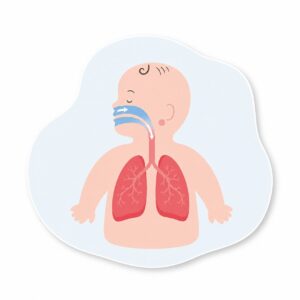 reduce hazards in the sleep environment that can interfere with breathing. Most sudden and unexpected deaths in infancy (SUDI), including fatal sleeping accidents, occur when sleep environments contain hazards that obstruct or compromise a baby’s airway.
This animation from the Raising Children’s Network [6] illustrates how an infant airway works and how caregivers can protect their baby’s airway across different sleep settings: https://raisingchildren.net.au/newborns/videos/protecting-baby-airways-animation
The airway protection model and the recommendations outlined here align with the Queensland Clinical Guidelines for Safer Infant Sleep [2], the International Society for the Study and Prevention of Perinatal and Infant Death [7], the Australian Breastfeeding Association [8,9], the Raising Children’s Network [10,11], Little Sparklers [12] and the Australian Competition and Consumer Commission Sleep Bub Safe Campaign [13].
Consistent with the key principle Easy to breathe – safe to sleep [2], the following guidance is organised into simple, easy-to-remember ‘gist’ messages: Face Up, Face Clear, Keep Close, Clear Space, Smokefree, Breastfeed. These are accompanied by practical ‘how to’ advice to help families create safer sleep environments for babies.
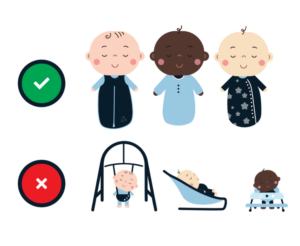
• Place your baby on their BACK for sleep on a firm, flat, level surface
• This position supports infant arousal and protects against airway obstruction.
• Avoid inclined or propped positions (eg rockers, propped on pillows) for sleep or whenever baby is unobserved for a period of time as this causes chin to chest positioning which can obstruct baby’s airway
• Start every sleep on the back, even once your baby learns to roll. Once baby can roll, let baby find their own position in their sleep space.
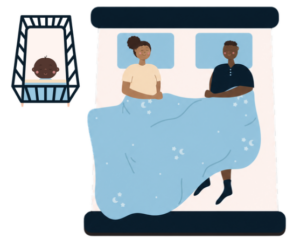 • Sleep your baby in a clear sleep space in your room for the first 6–12 months of life.
• Being close to your baby helps you respond quickly and supports your baby’s breathing and arousal reflexes.
• Close contact and responsivity also builds your baby’s brain through serve and return interactions and supports breastfeeding
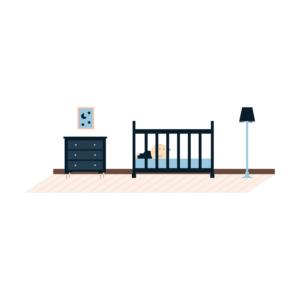
A clear space is one in which your baby can breathe easily. Families use different sleep arrangements depending on their home, culture and resources. Whether your baby sleeps in a cot, a bassinet or shares a sleep surface with a caregiver, the aim is the same: a simple, firm, flat, level space where your baby’s face stays clear, their body can move, and their airway remains open [14].
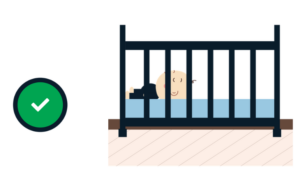
A cot or bassinet provides a dedicated sleep area that helps keep your baby’s face clear and airway protected. If using a cot or portable cot, ensure the device meets mandatory standards (AS/NZS 2172)
• Place the cot or bassinet on a flat, level floor in a low‑traffic area.
• Use a firm, well‑fitted mattress with no more than a 2 cm gap around the edges.
• Use a fitted sheet (or a flat sheet tucked firmly).
• If using blankets, place your baby with their feet at the bottom of the cot (Feet-to-foot) and keep blankets tucked firmly below the shoulders.
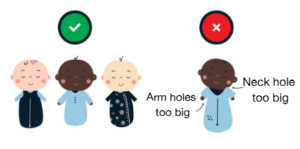
• Consider a well‑fitting infant sleeping bag or sleep suit with fitted neck and arm holes and no hood, instead of loose bedding.
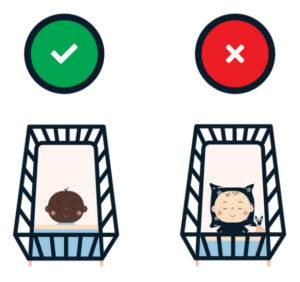
• For older infants who can climb, leave at least a 30 cm gap between the cot and walls or furniture.
• Keep the space empty—no pillows, bumpers, toys, soft-sided nests, lambswool, extra padding or heavy bedding or positioners.
• If your baby can roll, avoid wrapping or swaddling when placing them to sleep, and ensure arms are free (not constrained by wrap or clothing).
• Position the cot away from blind/curtain cords and electrical cables.
• Remove attached items such as mobiles or change tables to prevent hazards.
Bassinets (for babies under 4 months):
• Place the bassinet on the floor, not on furniture, to reduce fall risks.
• Follow the same firm, flat, clear‑space principles as cots.
• Avoid adding ‘extra’ mattresses or padding to baby’s sleep surfaces to make it softer. Soft surfaces increase suffocation risk.
Many families share a sleep surface with their baby for cultural, practical or personal reasons, or because other options are limited. Shared sleep and breastfeeding are also frequently associated practices. Shared sleep, often referred to as bedsharing or co-sleeping, occurs intentionally and unintentionally. Considering potential sleep environments is therefore important particularly where shared sleep is possible when caring for your baby. When sharing a sleep surface, creating a clear space helps keep your baby’s airway open.
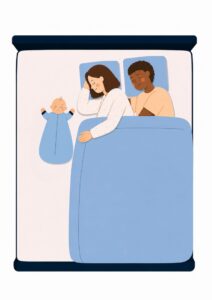
• Use a firm, flat mattress placed on a level surface (avoid air mattresses where possible)
• Place the mattress in a low‑traffic area where no one will step over the baby.
• Keep a 30 cm gap between the mattress and walls or furniture.
• Place your baby on their back for sleep.
• Ensure a clear space around your baby; about 30 cm on all sides.
• Position baby next to one adult only, not between two adults or next to another child or pet.
• Keep adult pillows and bedding away from the baby’s face. If using a blanket, keep it tucked under the adult and away from baby.
• Dress the baby in a sleep suit or sleeping bag rather than using adult bedding.
• Do not wrap or swaddle a baby who is sharing a sleep surface; arms and legs need to be free to allow movement
• Adults with long hair should tie it back to keep the baby’s face clear.
Important: Avoid soft, curved, sloping or improvised surfaces, including couches, chairs, bouncers, rockers or car seats for sleep. These surfaces increase the risk of entrapment and/or chin on chest positioning which can increase a baby’s airway becoming blocked.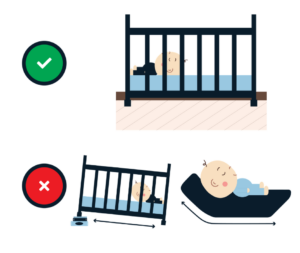
Where it is possible to fall asleep during feeding or settling your baby, consider an alternative firm, flat, level sleep space where you can create a clear space around your baby. For example, it may be safer to lie down on an adult mattress that is clear of pillows and bedding than fall asleep on a sofa.
The recommendations described here for both separate and shared sleeping practices support practical planning for airway protection – keeping the face uncovered, avoiding chin‑to‑chest positions, avoiding entrapment and ensuring nothing can press on the chest or tummy. These principles are relevant regardless of the sleep setting a family uses and regardless of risk profile.
If you are interested in learning more about creating safer sleep environments in diverse settings, including in emergencies or out-of-routine circumstances, please see the following resources:
Australian Breastfeeding Association: Breastfeeding and Co-sleeping: https://www.breastfeeding.asn.au/resources/co-sleeping
Little Sparklers: https://littlesparklers.org/infant-and-toddler-sleep/realistic-expectations-for-infant-and-toddler-sleep
Raising Children’s Network: https://raisingchildren.net.au/newborns/sleep/where-your-baby-sleeps/co-sleeping
Australian Breastfeeding Association: Safer sleep in emergencies https://www.breastfeeding.asn.au/sites/default/files/2024-09/INFO-BushfireProject-Safer%20sleep%20in%20emergencies-V1-WEB.pdf
· Keep your baby’s environment smoke‑free before and after birth.
· Cigarettes, marijuana smoke and vaping aerosols reduce a baby’s arousal and protective airway reflexes increasing risk of suffocation if baby’s airway becomes blocked.
· Keep the car and home a smoke‑free zone; change clothes and wash hands after exposure.
 · Breastfeed baby
· The World Health Organisation supports breastfeeding exclusively for the first 6 months with continued breastfeeding up to 2 years and beyond
· Breastfeeding is recommended because it provides optimal nutrition for infants while supporting healthy growth, development, and immune protection. It reduces the risk of infections, chronic disease, and sudden infant death, and also benefits maternal health. Breastfeeding additionally supports bonding and contributes to improved long-term health outcomes for both mother and baby.
· Breastfed infants tend to have lighter sleep cycles and wake more often, making them more responsive to physiological challenges such as reduced oxygen or airway obstruction; a mechanism thought to contribute to the reduced risk of SUDI
· Any breastfeeding is helpful; continue for as long as works for you and your baby.
ACKNOWLEDGEMENT
This material was prepared by Professor Jeanine Young AM for use by River’s Gift. The Recommendations herein align with the Queensland Clinical Guideline Safer Infant Sleep, the Raising Children’s Network and the International Society for the Study and Prevention of Perinatal and Infant Death.
REFERENCES
1. The State of Queensland (Queensland Family and Child Commission) (2025) Annual Report: Deaths of Children and Young People, Queensland 2023-24. QFCC; 2025. Accessed May 19, 2025: https://www.qfcc.qld.gov.au/what-we-do/child-death-prevention/child-death-reports-and-data
2. Queensland Clinical Guidelines. Safer infant sleeping. Guideline No. MN22.71-V1-R27. Queensland Health. 2022. (Young J, McEniery J, Clinical Co-Leads). https://www.health.qld.gov.au/__data/assets/pdf_file/0025/1166353/g-safer-sleep.pdf
3. Cowan S. (2021) Your Tube Card. Change for our Children New Zealand. Available at: https://irp.cdn-website.com/488c9a2d/files/uploaded/Your_Tube_Cards-d7440fb2.pdf
4. Young J, Cowan S, Kearney L, Watson K, Craigie L. (2020) A strategy to promote safe sleeping environments and reduce the risk of Sudden Unexpected Death in Infancy in Aboriginal and Torres Strait Islander communities. (ID: 99489008702621) Final Implemetation Project Report for the Department of Child Safety, Youth and Women, Queensland Government, 2018. Available at https://doi.org/10.25907/00011
5. Young J, McEniery J, Cruice D, Thompson JMD. (2022) Reducing Infant Mortality in Queensland: the impact of the Pēpi-Pod® Program. Australian College of Midwives, 2022 24th ACM National Conference: Together at the Top, Cairns, 13-15th September, 2022. Women and Birth, 35, Supplement 1: 10-10. https://doi.org/10.1016/j.wombi.2022.07.028
6. Raising Children’s Network (2026). Protecting your baby’s airways animation. Available: https://raisingchildren.net.au/newborns/videos/protecting-baby-airways-animation [Jeanine Young was acknowledged as key content advisor]
7. International Society for the Study and Prevention of Infant Death. (2023) Safe Infant Sleep Recommendations: Evidence Based Guidelines Consensus Statement. Available https://www.ispid.org/fileadmin/user_upload/textfiles/ISPID_Safe_Sleep_Recommendations_23_Aug_2023__final_120623.pdf
8. Australian Breastfeeding Association (2026). Breastfeeding and co-sleeping. Australian Breastfeeding Association. Accessed 10 March 2026: https://www.breastfeeding.asn.au/resources/co-sleeping
9. Australian Breastfeeding Association, KidSafe Queensland Inc. & University of the Sunshine Coast. (2024). Supporting safer sleep for babies in evacuation centres: an emergency planning resource [fact sheet]. Australian Breastfeeding Association. Accessed May 19, 2025: https://www.breastfeeding.asn.au/sites/default/files/2024-09/INFO-BushfireProject-Safer%20sleep%20in%20emergencies-V1-WEB.pdf
10. Raising Children’s Network. (2024) Co-sleeping with your baby. Raising Children’s Network: raisingchildren.net.au (Young acknowledged as expert author and advisor). Accessed May 19, 2025: https://raisingchildren.net.au/newborns/sleep/where-your-baby-sleeps/co-sleeping
11. Raising Children’s Network. (2024) Baby airway protection during sleep, travel, play and feeding. Raising Children’s Network: raisingchildren.net.au (Young acknowledged as expert author and advisor). Accessed May 19, 2025: https://raisingchildren.net.au/babies/safety/choking-strangulation/baby-airway-protection
12. Little Sparklers (2024) Realistic expectations for infant and toddler sleep. Little Sparklers (Young acknowledged as expert author and advisor). Accessed May 19, 2025: https://littlesparklers.org/infant-and-toddler-sleep/realistic-expectations-for-infant-and-toddler-sleep
13. Australian Competition and Consumer Commission (2024) Sleep Bub Safe Campaign (First Nations Sleep Bub Safe resources: video, poster and online content). [Young was key content advisor, reframed content: death to breath, strength-based language] Australian Government, Canberra. Accessed May 19, 2025: https://www.productsafety.gov.au/about-us/our-campaigns/sleep-bub-safe
14. Barker R, Young J, Niven C, Teerds S. (Infant Safe Sleeping Working Group) (2022) Best practice guide for the design of safe infant sleeping environments: A guide for industry to reduce the risk of death and life-threatening injuries in infants. Accessed May 19, 2025: https://www.productsafety.gov.au/about-us/publications/best-practice-guide-for-the-design-of-safe-infant-sleeping-environments
15. Young J. (2022). Baby sling safety is under the spotlight – a 5-point checklist can keep infants safe. [on-line]. The Conversation. Accessed May 19, 2025: https://theconversation.com/baby-sling-safety-is-under-the-spotlight-a-5-point-checklist-can-keep-infants-safe-190971

