Safe Sleep

Easy to Breathe. Safe to Sleep.

Here you’ll learn about the essential safe sleep principles that every parent, grandparent and caregiver should know. Our guidelines are simple yet powerful, designed to protect the most vulnerable among us during their most peaceful moments – sleep.


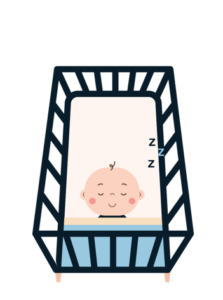
When a baby sleeps safely, it’s easy for them to breathe.

Babies are still developing the strength and reflexes that help keep their airways open. Safe sleep environments help protect your baby’s breathing while they sleep.

The key idea is simple:

Easy to breathe = Safe to sleep.

Remember ABC Safe Sleep.


ABC SAFE SLEEP


 — Airway


Protect your baby’s airway so they can breathe easily.

Babies sleep safely when:

✔ their face is clear and uncovered

✔ their head and neck stay in a neutral position

✔ nothing presses on their chest or tummy

Because babies are still developing the ability to move if their breathing becomes blocked, caregivers play an important role in protecting their airway during sleep.

LEARN MORE ABOUT PROTECTING YOUR BABY’S AIRWAY


Click here to watch a short video on how to help protect your baby’s airway during sleep.

— Back


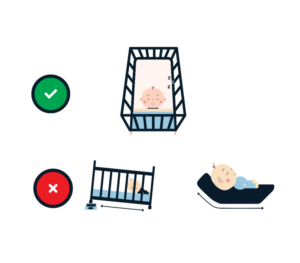
Always place your baby on their back for every sleep.

Sleeping on the back helps keep the airway open and supports a baby’s natural waking reflex if breathing becomes difficult.

Start every sleep on the back — for both day and night sleep.

Avoid letting babies sleep in:

· rockers

· propped positions

· pillows

· inclined loungers or seats

These positions can cause the head to fall forward and block the airway.


— Close & Clear


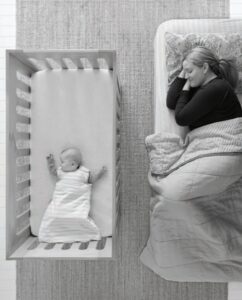
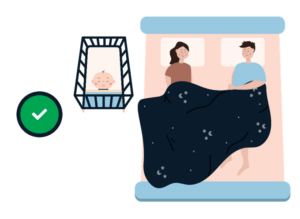
Keep your baby close to you and in a clear sleep space.

Sleep your baby in your room for the first 6–12 months. 

Being close helps you respond quickly and supports your baby’s breathing and arousal reflexes.


A safe sleep space should be:

✔ firm and flat

✔ free of pillows, toys and bumpers

✔ clear of soft bedding or nests

A clear sleep space helps keep your baby’s airway open while they sleep.


WHY SAFE SLEEP MATTERS

Most sudden and unexpected infant deaths occur when sleep environments contain hazards that interfere with a baby’s breathing.

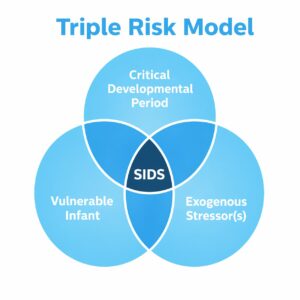
Researchers often explain these deaths using something called the Triple Risk Model.

LEARN MORE ABOUT THE TRIPLE RISK MODEL HERE


THE IMPORTANT MESSAGE FOR PARENTS

We cannot always control a baby’s vulnerability or stage of development.

But we can control the sleep environment.

By creating safe sleep environments that protect your baby’s airway and support easy breathing, families can significantly reduce the risk of sudden infant death.

That’s why remembering ABC Safe Sleep is so important.


ADDITIONAL SAFE SLEEP PRACTICES

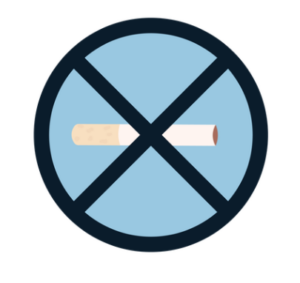
Keep your baby smokefree

Exposure to cigarette smoke, vaping or marijuana smoke affects the reflexes babies use to wake and respond if breathing becomes difficult.

Keep your baby’s environment completely smoke-free before and after birth.


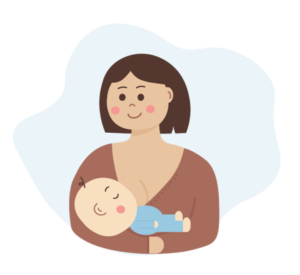
Breastfeeding supports safer sleep


Breastfeeding provides many health benefits and is associated with a reduced risk of sudden infant death.


Breastfed babies tend to wake more easily and respond faster to breathing challenges.

Any breastfeeding is beneficial.


LEARN MORE ABOUT OTHER COMMON INFANT CARE PRACTICES


ACKNOWLEDGEMENT

This material was prepared by Professor Jeanine Young AM for use by River’s Gift. The Recommendations herein align with the Queensland Clinical Guideline Safer Infant Sleep, the Raising Children’s Network and the International Society for the Study and Prevention of Perinatal and Infant Death.

REFERENCES

1. The State of Queensland (Queensland Family and Child Commission) (2025) Annual Report: Deaths of Children and Young People, Queensland 2023-24. QFCC; 2025. Accessed May 19, 2025: https://www.qfcc.qld.gov.au/what-we-do/child-death-prevention/child-death-reports-and-data

2. Queensland Clinical Guidelines. Safer infant sleeping. Guideline No. MN22.71-V1-R27. Queensland Health. 2022. (Young J, McEniery J, Clinical Co-Leads). https://www.health.qld.gov.au/__data/assets/pdf_file/0025/1166353/g-safer-sleep.pdf

3. Cowan S. (2021) Your Tube Card. Change for our Children New Zealand. Available at: https://irp.cdn-website.com/488c9a2d/files/uploaded/Your_Tube_Cards-d7440fb2.pdf

4. Young J, Cowan S, Kearney L, Watson K, Craigie L. (2020) A strategy to promote safe sleeping environments and reduce the risk of Sudden Unexpected Death in Infancy in Aboriginal and Torres Strait Islander communities. (ID: 99489008702621) Final Implemetation Project Report for the Department of Child Safety, Youth and Women, Queensland Government, 2018. Available at https://doi.org/10.25907/00011

5. Young J, McEniery J, Cruice D, Thompson JMD. (2022) Reducing Infant Mortality in Queensland: the impact of the Pēpi-Pod® Program. Australian College of Midwives, 2022 24th ACM National Conference: Together at the Top, Cairns, 13-15th September, 2022. Women and Birth, 35, Supplement 1: 10-10. https://doi.org/10.1016/j.wombi.2022.07.028

6. Raising Children’s Network (2026). Protecting your baby’s airways animation. Available: https://raisingchildren.net.au/newborns/videos/protecting-baby-airways-animation [Jeanine Young was acknowledged as key content advisor]

7. International Society for the Study and Prevention of Infant Death. (2023) Safe Infant Sleep Recommendations: Evidence Based Guidelines Consensus Statement. Available https://www.ispid.org/fileadmin/user_upload/textfiles/ISPID_Safe_Sleep_Recommendations_23_Aug_2023__final_120623.pdf

8. Australian Breastfeeding Association (2026). Breastfeeding and co-sleeping. Australian Breastfeeding Association. Accessed 10 March 2026: https://www.breastfeeding.asn.au/resources/co-sleeping

9. Australian Breastfeeding Association, KidSafe Queensland Inc. & University of the Sunshine Coast. (2024). Supporting safer sleep for babies in evacuation centres: an emergency planning resource [fact sheet]. Australian Breastfeeding Association. Accessed May 19, 2025: https://www.breastfeeding.asn.au/sites/default/files/2024-09/INFO-BushfireProject-Safer%20sleep%20in%20emergencies-V1-WEB.pdf

10. Raising Children’s Network. (2024) Co-sleeping with your baby. Raising Children’s Network: raisingchildren.net.au (Young acknowledged as expert author and advisor). Accessed May 19, 2025: https://raisingchildren.net.au/newborns/sleep/where-your-baby-sleeps/co-sleeping

11. Raising Children’s Network. (2024) Baby airway protection during sleep, travel, play and feeding. Raising Children’s Network: raisingchildren.net.au (Young acknowledged as expert author and advisor). Accessed May 19, 2025: https://raisingchildren.net.au/babies/safety/choking-strangulation/baby-airway-protection

12. Little Sparklers (2024) Realistic expectations for infant and toddler sleep. Little Sparklers (Young acknowledged as expert author and advisor). Accessed May 19, 2025: https://littlesparklers.org/infant-and-toddler-sleep/realistic-expectations-for-infant-and-toddler-sleep

13. Australian Competition and Consumer Commission (2024) Sleep Bub Safe Campaign (First Nations Sleep Bub Safe resources: video, poster and online content). [Young was key content advisor, reframed content: death to breath, strength-based language] Australian Government, Canberra. Accessed May 19, 2025: https://www.productsafety.gov.au/about-us/our-campaigns/sleep-bub-safe

14. Barker R, Young J, Niven C, Teerds S. (Infant Safe Sleeping Working Group) (2022) Best practice guide for the design of safe infant sleeping environments: A guide for industry to reduce the risk of death and life-threatening injuries in infants. Accessed May 19, 2025: https://www.productsafety.gov.au/about-us/publications/best-practice-guide-for-the-design-of-safe-infant-sleeping-environments

15. Young J. (2022). Baby sling safety is under the spotlight – a 5-point checklist can keep infants safe. [on-line]. The Conversation. Accessed May 19, 2025: https://theconversation.com/baby-sling-safety-is-under-the-spotlight-a-5-point-checklist-can-keep-infants-safe-190971